
Liver diseases, whether chronic, acute, or cancerous, represent a major cause of morbidity and mortality worldwide. Faced with the critical shortage of grafts and the lack of reliability of current preclinical models for evaluating treatment efficacy, Team 1 leverages its combined expertise in cellular plasticity and bioengineering. Our mission is to design and develop innovative hepatic systems, ranging from advanced cellular constructs like Organoids and patient-specific Tumoroids/PDOs to ex vivo support and repair platforms, to accelerate fundamental research, drug evaluation, and the development of new therapies for the liver.
Organoids are three-dimensional cellular structures that, by self-assembling and self-organizing, partially reproduce the architecture and functions of native tissues. They can be generated from differentiated pluripotent stem cells (ESCs and iPSCs), adult stem cells (ASCs), or primary cells cultured in a 3D environment. Liver organoids represent a major breakthrough in both fundamental research and regenerative medicine. They have proven to be powerful tools for disease modeling, toxicological studies, and drug screening. Beyond these applications, they provide sophisticated experimental platforms to investigate developmental mechanisms, self-organization processes, cell-cell interactions, and signaling pathway modulation, especially when coupled with emerging technologies such as genetic engineering and multi-omics approaches. Organoids also offer promising perspectives for personalized medicine, as they can be derived from healthy or diseased tissues, paving the way for patient-specific therapeutic platforms.
Building on organoid technology, researchers are actively developing advanced cancer models known as “tumoroids” (“tumor-like organoid”) or patient-derived organoids (PDOs). These models are generated from from primary or metastatic tumor samples and rely on the presence of cancer stem cells (CSCs). Similar to normal stem cells, CSCs have the capacity of self-renewal and differentiation, but unlike their normal counterparts, which remain mostly quiescent, they are key drivers of tumor initiation, aggressiveness, recurrence, and treatment resistance. PDOs therefore provide a clinically relevant platform to study cancer biology and patient-specific therapeutic response. Beyond simple drug screening, PDOs are crucial tools for deciphering therapeutic response mechanisms. They notably enable the identification of specific gene signatures associated with treatment sensitivity or resistance. Our research particularly focuses on embryonic signatures, whose expression is a key driver of tumor aggressiveness and strongly modulates the efficacy of anti-cancer therapies.
To overcome the limitations of standard models, which lack perfusion and complex interactions, the development of more sophisticated systems, referred to as Assembloids, is needed. These advanced constructs integrate vascularization and other cell types to better replicate physiological conditions and the native hepatic microenvironment.
The accurate prediction of drug toxicity and efficacy on human liver tissue remains a crucial challenge in pharmaceutical development. Conventional preclinical models used in pharmaco-toxicological studies often fail to reproduce human specific responses, leading to poor translatability of animal data. To address this gap, microfluidic devices, or organ-on-chip (OoC) systems, have been developed. These platforms recreate dynamic microenvironments with controlled fluid flow, enabling real-time monitoring of drug distribution and cellular responses under physiologically relevant conditions.
In case of severe or fulminant hepatitis and acute-on-chronic liver failure (ACLF), the first supportive therapies were artificial livers, which are acellular extracorporeal devices (MARS®, Prometheus®, and SPAD). These systems focused solely on detoxification, but clinical outcomes have been disappointing, showing limited impact on survival.
In response, a new generation of systems has emerged, incorporating cells within bioreactors. These bio-artificial livers (BALs), which are extracorporeal bioreactors filled with hepatocytes, are designed to provide both detoxification and synthetic functions. They aim to bridge patients to transplantation or, ideally, promote recovery without the need for grafts. Nevertheless, restoring liver function alone is not sufficient to control the inflammatory response associated with ALF.
With the increasing discard rate of donor livers machine perfusion technologies have regained major interest. Three main concepts are now implemented worldwide. Three main concepts have been introduced worldwide. First, normothermic regional perfusion (NRP) is performed directly in the donor after circulatory death (DCD) enabling early assessment of organ viability before any cold ischaemia. Second, ex situ normothermic machine perfusion (NMP) can be applied during transport or upon arrival at the recipient center replacing cold storage and preserving liver function. Third, hypothermic oxygenated perfusion (HOPE) is applied after cold storage, to reintroduce oxygen at cold temperatures. Robust evidence indicates that HOPE protects mitochondrial function, mitigates ischaemia–reperfusion injury (IRI), and ultimately reduces post-transplant complications.Extending ex-situ perfusion for several days represents a major frontier to enable organ repair and optimization prior to transplantation.
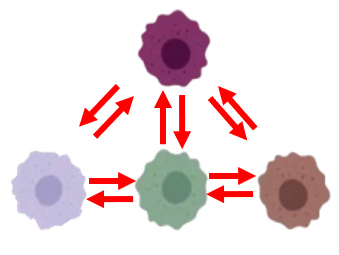
Cellular plasticity is the ability of a cell to reversibly acquire the cell fates or phenotypes of other cell types. Key processes like Epithelial-Mesenchymal Transition (EMT) and its reverse (MET) are essential for establishing the epithelial polarity needed for proper liver architecture and function in native tissue and in our bioconstructs. While highly controlled in adults, aberrant plasticity in response to stress or damage can lead to severe diseases (steatosis, fibrosis) and drive cancer progression by generating CSCs. Deciphering the factors and the mechanisms involved in polarity and plasticity is thus crucial to stabilize epithelial tissues and prevent disease progression.
Extracellular Vesicles (EVs) are lipid nanoparticles released by cells, acting as complex intercellular messengers by transferring proteins, lipids, and nucleic acids. In liver pathology, they reflect the state of the cells from which they originate, making them highly relevant non-invasive biomarkers for diagnosis and prognosis. Furthermore, their bioactive content gives them a direct therapeutic potential by modulating tissue regeneration and inflammatory response in severe liver diseases. Therefore, exploiting EVs as both diagnostic markers and therapeutic agents is a major strategy for developing theragnostic tools against severe liver disorders.
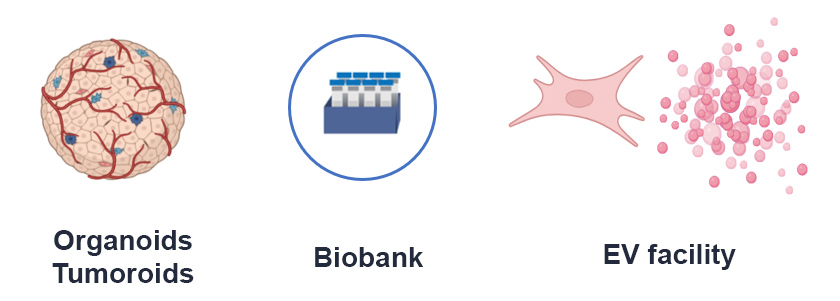
Chairs: Eleanor Luce (Engineer) and Hind Guenou (MCU).
Chairs: Ama Gassama-Diagne (DR. INSERM) and Julien Giron-Michel (CRCN INSERM).
Chairs: Juliette Peltzer (researcher), Faouzi Saliba (Professor and Practitioner of Hepatology) and Marc-Antoine Allard (PUPH).
Team Expertise and Fundamental Axes
Team 1 brings together complementary expertise in the development of human pluripotent stem cell-derived therapies, Mesenchymal Stromal Cells (MSCs) and their secretome, including extracellular vesicles (EVs), as well as advanced bioengineering technology.
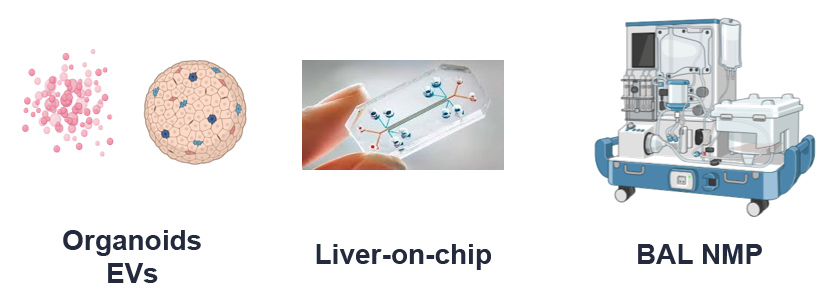
The team aims to design and develop innovative tools such as organoids, assembloids, tumoroids, extracorporeal liver systems and ex vivo liver graft repair strategies. These bioengineered systems are evaluated through preclinical and translational models to enhance liver function, promote tissue repair, and prevent liver damage after acute injury.
The unit benefits from state-of-the-art platforms dedicated to the clinical development of therapeutic products. This includes the iVEs platform (Villejuif) is specialized in the isolation, characterization, and production of clinical-grade EVs using Tangential Flow Filtration. Within CTSA (Clamart), the UMTI (Unité de médicaments de thérapie innovante) provides GMP-compatible facilities for somatic cell therapy (MSCs) and will be adapted to support EV-focused applications. Together, these infrastructures ensure robust clinical translation, enabling the production of therapeutic MSC-derived EVs for future applications in severe liver diseases.
In parallel, a fundamental research axis focused on unraveling the mechanisms of liver cell plasticity across various pathological contexts. A dedicated line of investigation also explores the role of EVs as biomarkers and potential therapeutic agents in severe liver diseases and regeneration processes.